

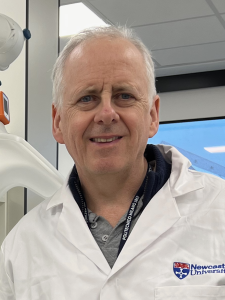
Prof. Mark Geoghegan
Roland Cookson Professor of Engineering Materials, Newcastle University
Mark Geoghegan has held the Roland Cookson Chair in Engineering Materials in the School of Engineering at Newcastle University since 2019. He was previously Professor of Soft Matter Physics at the University of Sheffield, which he joined in 2000. Mark has had postdoc positions in Bayreuth, Freiburg (where he was a Humboldt Fellow) in Germany, and CE-Saclay in France. His PhD was obtained in the Cavendish Laboratory in Cambridge in 1994. Mark is a Fellow of the Institute of Physics and the Royal Society of Chemistry. Beyond adhesion, his wider interests cover polymer science, and he has written a book (with Georges Hadziioannou) on Polymer Electronics, published by OUP. He has significant experience in polymer films, soft nanotechnology, and cellular adhesion. He has held visiting Professor positions in Modena, Strasbourg, and Bordeaux.
A Water-based Reversible Glue
A one-pot water-based reversible (debond-on-demand) adhesive that is scalable, inexpensive, based on commodity materials, and has a long shelf life is described. It exhibits excellent adhesion on different substrates, including plastic surfaces. Reversibility allows for the surfaces to be detached after immersion in high or low pH solution, depending on the formulation. Solvents such as acetone also work. The glue comprises polymer latex particles stabilized by polyelectrolytes and appropriate filler particles. Metal fillers permit a conducting glue.
Here, the emulsion polymerization of styrene and butyl acrylate, stabilized with either physisorbed chitosan or poly(acrylic acid) chemically grafted to the polymers, is presented. Hydrotalcite, a cationic clay, and montmorillonite, an anionic clay were added to the polycationic and polyanionic formulations respectively, at different concentrations. These provide formulations that, when coated onto a suitable substrate, adhere with lap shear strength (ISO 4587) of up to 1.5 MPa. The adhesion can be reversed by immersion in high (> 12) or low pH (< 3) water for polyanionic and polycationic formulations respectively. By heating the polyanionic sample under alkaline (pH 14) conditions to 85°C under mechanical agitation, reversibility can be on a time scale of ~30 minutes. Under these conditions, the adhesive detaches the substrate, leaving clean surfaces, ready for recycling.
The polyanionic emulsion is also presented with silver nanoparticles replacing the montmorillonite. Here, a best conductivity of 2.9 × 10⁵ S m⁻¹ is achieved, compared to 8 × 10⁶ S m⁻¹ for a good solder. It is also comparable with other conducting glues. Its unique property of reversibility means that it is very well placed to address problems in the recycling of electronic waste, which is a significant societal and environmental problem.
Co-authors:
Adriana Sierra-Romero, Katarina, Novakovic, Bassam A Aljohani, Ama B. Asiedu-Asante, Emmanuel Abotsi, and Volker Pickert. All are affiliated with the School of Engineering in Newcastle University.
Breakout Session VI – Reversible & On‑Demand Debonding – 17 September 2026 – 11:00 – 11:30 – Room Whittle – F3