

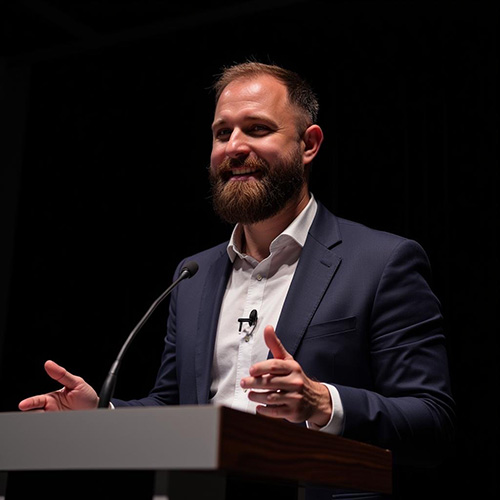
Adrien Schmidt
Head of Business Development, Innotech Marketing und Konfektion Rot GmbH
Adrien Schmidt is Head of Business Development and Trainer for Bonding Technologies at Innotech Marketing und Konfektion Rot GmbH. With a background in R&D and Application Engineering at WEVO CHEMIE, he specializes in providing turnkey solutions for adhesive manufacturers and end users. As a certified DVS®-EWF® Adhesive Bonding Technologist, he combines practical industry expertise with his chemical engineering studies at Reutlingen University. His current focus is on enhancing the eectiveness and application of bonding technologies through innovative solutions and comprehensive training programs.
What a Drop Can Tell
Surface quality is a decisive factor in the performance, durability, and reproducibility of bonding, coating, and painting processes. Yet in many manufacturing environments, surface readiness is still judged using indirect or subjective methods that provide limited process insight. This presentation shows how contact-angle measurement can help reinvent this critical interface by turning surface evaluation into an objective, non-destructive, and data-driven quality tool.
By quantifying the interaction of a liquid droplet with a substrate, contact-angle measurement provides actionable information on surface energy, cleanliness, and the likelihood of reliable adhesion or coating performance. In comparison with conventional screening methods such as water-break tests or dyne pens, it delivers reproducible values that make contamination, insufficient cleaning, incomplete activation, or surface drift visible before they lead to failure.
The presentation focuses on the practical value of integrating contact-angle measurement along the production chain: from incoming parts inspection and process setup to routine quality assurance and troubleshooting. Used early and repeatedly, the method supports process stability, reduces operator subjectivity, and enables better control of critical pre-treatment steps.
As a non-destructive approach, contact-angle measurement is particularly attractive for modern production environments that demand higher robustness, lower scrap rates, and faster root-cause analysis across a wide range of materials and geometries. The result is improved adhesion reliability, fewer coating defects, less rework, and a more resilient manufacturing process. In that sense, surface metrology becomes more than a lab method: it becomes an enabler of smarter, more efficient, and future-ready production.
Co-author:
Buruk Sen
Breakout Session XV – Next-Generation Adhesives & Sealants Chemistry – 18 September 2026 – 11:00 – 11:30 – Room Churchill – GF